Wednesday, December 18, 2013

All the Fat that's Fit to Talk*

There has been a lot of research on "fat talk" and increasing talk about it being harmful. "Fat talk" is shorthand for hating on your body. And usually fat is denigrated in the process. There is even a Fat Talk Free Week, which typically results in an awareness video every year.

But ever since the fight about fat talk rose to the surface, fat activists have been questioning it. The word fat isn't inherently bad. Fat activists use it all the time...proudly. Saying we need to stop 'fat talk' usually implies we need to stop saying the word fat.

In fact, Jennifer Lawrence recently said it should be illegal to call someone fat on TV.

And it's no coincidence that it's mainly women who are already thin are the ones who can speak out about fat talk. This is part of the huge problem with fighting beauty ideals. When someone like Jennifer Lawrence gets called fat, we are legitimate in empathizing with her...because we know she's not fat. It's therefore cruel and not true and undeserved. If I remember my Mimi Nichter correctly, she talks specifically about how fat girls cannot engage in fat talk. People cannot reassure us, and engaging in fat talk only draws attention to our fat bodies. Fat talk is a way of bonding with other girls/women, but fat girls can only do the reassuring, not the fat talking.

The fight against fat talk isn't even about fat people--and that's really frustrating, actually. No one is fighting against shaming our bodies. Society still thinks it's proper to shame us. As proof, please note that Michelle Obama just appeared on The Biggest Loser for the 2nd time. Not to mention that the U.S. Postal Service partnered with The Biggest Loser a few years back. Not to mention that the show The Biggest Loser EXISTS.

No, the fight against fat talk is an innocuous everybody-is-beautiful fight. Don't get me wrong, we should fight against people's uncritical and casual body hatred--even more importantly, we should fight against the culture of body hate and the societal structures that support it.

More evidence that the fight on fat talk is no friend to fat people is the latest Special K commercial:


According to the commercial, "93% of women fat talk. We believe it's a barrier to managing their weight."

Yes, that's correct. We need to end fat talk because it is a hindrance to weight loss.

ARE YOU KIDDING ME?

When 'end fat talk' is co-opted by a corporation known for fat shaming and promoting the weight loss uses of their products, we KNOW ending fat talk is not about fat people.

If you look at the website they have created, you can see that they are using FAT SHAME to promote this campaign:
-Fat talk weighs down all women.
-Join us and tip the scales toward positivity.

While fat activists don't own all the fat puns (even though we would like to), talk of "weighing down" sure brings up images of fat shame. This is even more explicit given their focus on how fat talk hinders "weight management success."

They are making money off of anti-body shame WHILE FAT SHAMING.

They aren't the first company to co-opt feminism or fat activism. In fact, I guessed that the commercial was either for Jenny Craig or Weight Watchers, both who have co-opted fat activist language.

This is why this 'feel good' activism is dangerous. It feels right to say how horrible it is for these women to fat talk and hate on their bodies. It feels like good is winning. It feels like someone gets it. It feels like someone cares.

Rest assured, Special K does not care about fat people. And the fight against fat talk will continue to seem like it's about fat people while continuing to maintain structures that oppress us.


*The title is a reference to Natalie Boero's article, "All the News that's Fat to Print."


Saturday, April 21, 2012

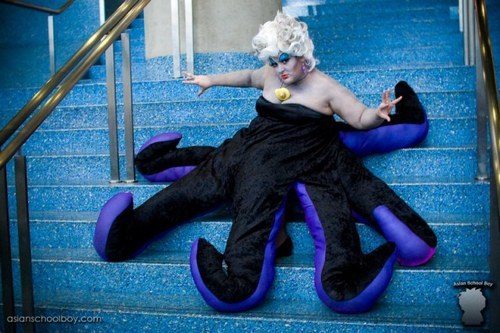
What does the Ursula Doll mean to you, fatties?

Today the fabulous TheSugarMonster alerted me to the existence of an Ursula Doll made by Disney. And, as we used to say growing up, I about had a cow.

I tried to explain why this is such a big deal to me on Twitter, but I'm not sure I can fully express why my immediate response was I WANT ONE RIGHT NOW. I know there are problems with the Ursula character and trends among fat Disney characters, but Ursula is so magnificent. When I first saw fat girls creating Ursula costumes for Halloween, I was filled with indeterminate squee.


I also find it incredibly disappointing that Broadway Ursula is not fat.


In our discussion on Facebook, TheSugarMonster said, "WE NEED THIS WITH EVERY FIBER OF OUR BEINGS." Yes, Ursula is that goddamn important. 

When I told her I wanted to write a piece asking folks to explain what an Ursula Doll means to them, she said: 

Ursula was a bad ass fat bitch who got she wanted and didn't apologize for her size OR her evil. Being that she was based on Divine...there's a reason they're two of my biggest inspirations.

Yes, Ursula was based on Divine, meaning that she came from fat unapologetic fabulousness.


So what does the existence of an Ursula Doll mean to you? Is it important? Why?


Also feel free to post your favorite Ursula gif. Here's mine:

Wednesday, January 25, 2012

Fatness, Dissociation, & Dehumanization

This short film, FAT, begins by streaming voices repeating the word “fat” over shots of the subject, Margaret Donahoe’s, fat body, sometimes as she squeezes her fat together. After this, we finally see broken shots of her face, as she begins:

“My whole life growing up I had been taught to dislike my body, and specifically my fat/ I had been dissociating my from my body/ you really cement this separation between your self and your body.”

[Trigger warning for body issues & fat shaming.]


FAT from Margaret Donahoe on Vimeo.

[FULL TRANSCRIPT available HERE.]

After her short narrative, she begins to interview friends (individually), who are seemingly answering the question, “Do you think that I am fat?” For the most part, her friends show immediate discomfort.

After their initial answers, her friends’ narratives are cleverly laid over one another in a way that I feel captures the complexity and intensity of the issue.

What strikes me most is the theme, as Margaret notes, of dissociation--a stark emphasis on the separation between the mind and the body. Fat people, more often than you might think, are told by friends that they aren’t fat. And that’s not necessarily because they aren’t large folks, but often because their friends do not want to label them, as her friend says, with “the kinds of awful connotations that come with that word in the society that we live in.”

I’d like to highlight a couple of quotes from the friends, which I should note are obviously clipped or cut and pasted in particular ways by Donahoe and Good, who made the film together for a class at Queen’s University last year:

“If I hadn’t gotten to know you, I sometimes wonder, and this is gonna sound bad, but I sometimes wonder if, like, if I would have seen you as-...someone.”

“I think that when I call somebody fat and if I were to describe you as fat to somebody else, I would be also describing you as someone like, horrible and disgusting and, you know… and that’s really really fucked up.”

“Looking at a picture of you from before, it’s a completely different person.”

“I guess fat is lard. That you cook with.”

“Cut the gristle off the meat.”

The end of the first quote, though constructed by the filmmakers, is telling. "I sometimes wonder if, like, if I would have seen you as-...someone.” The third quote is apparently referring to a photo of Margaret before she had lost some weight. While subtle, the friend's use of "it" to refer to fatter Margaret reveals the impulse for dissociation...and indeed the tension experienced in this impulse when talking about someone she sees as a person at the same time as she refers to an image she feels discomfort associating with that person. It's evocative of the notion that people can "shed an entire person," which reinscribes the thin-person-inside imagery. The last two quotes get at our tendency to reduce fat to an inanimate object, separate from individuals, separate, indeed, from humanity.

This may seem like overanalysing to folks who haven't paid much attention to this stuff, but dissociation and dehumanization are every day experiences for fat people.

In Killing Us Softly 4, Jean Killborne states, “Turning a human being into a thing is almost always the first step toward justifying violence against that person.” And in our society, we are told and shown that fat is a thing. Fat bodies are just thin bodies with too much fat. Fat is extra. Fat people are told, “Underneath all that fat is a thin person waiting to get out,” and, “You have such a pretty face,” both phrases that encourage fat people to dissociate from their bodies. Since fat bodies are bad, the cultural logic is that we should focus on fat people's 'inner beauty,' sometimes coded as their inner thin person, i.e. 'once you lose weight, you're inner beauty will finally shine through.' (See Mendoza for more on thin person inside as representation of beauty and goodness). **


As you can see above, we do this in our visual culture as well. Charlotte Cooper famously coined the term “headless fatties” to refer to the perpetual phenomenon of media outlets showing fat people only from the neck down--faceless objects, abject parts. It is a different kind of objectification than most feminists rail against, though the result is still dehumanizing. Without faces, we do not connect with headless fatties, we do not see them as people. Headlessness encourages us to dis-identify with them, to see them as fat parts, cultural monsters intended to invoke horror and disgust.

The logic of fat suits similarly aids us in dissociating personhood from fatness. If we know an actor or actress is wearing a fat suit, it's easier for us to justify enjoyment in the stereotypical and harmful depictions of fat people which they are temporarily embodying. After all, they aren't fat people at all; rather, they embody our ideal fat person--one who does have a thin person inside, one who can strip off and discard their abject fat "layer." (See Mendoza, again.) One can look also to the plethora of fat suit Halloween costumes for a more commonplace dehumanizing of fat people.

If you're not yet convinced about the ways in which fatness (and, indeed, fat people) are seen as seen as separate from our notions of humanity and personhood, I offer you an increasingly popular meme:

Note that in most depictions, the fat man* is shorter, signifying de-evolution (despite the fact that we have only gotten taller as a species over time).


These depictions take one step further, predicting the de-evolution from fat man directly to animal--specifically the pig. Fat folks are rather accustomed to insults which depict them as animals (pig, hippo, whale, etc.) rather than human beings.


These images, we should note, are commonly used by folks talking about food, exercise and/or obesity. Imagine, if you will, being a fat person in the audience or in a college classroom when this sort of image is put on the screen.

In this Ted Talk by Dean Bornish, the audience laughs uproariously when he gets to this slide:


The meme is so popular, they even have t-shirts. For a change of pace, you can sprinkle in some extra sexism. The second t-shirt actually depicts a fat woman as being lower than primates in the evolutionary meme.


It's no wonder Margaret's friends had such a hard time calling her fat.


______

*Note the androcentrism inherent in most representations of evolution, where 'man' stands in for 'human' evolution AND the whiteness of the images, which should not be not lost on anyone with any semblance of (Western) racial consciousness.

**Erin Remick (fat famously) mocks the "thin person inside" in her video Fat Dinosity.


Related Reading
Cooper, Charlotte. "Headless Fatties." CharlotteCooper.net.
Mendoza, Katharina R. 2011. "Seeing Through the Layers: Fat Suits and Thin Bodies in The Nutty Professor and Shallow Hal." The Fat Studies Reader. NY: NYU Press.

Monday, January 2, 2012

Fat off the Top--Linksisode

I know it may seem like a blogging cop-out, but I'm a fan of links. In fact, I often call myself an obsessive disseminator of information. If someone paid me to offer up great links, I would be living quite comfortably.

I love giving people new information...especially on stuff I love, so here goes...fat awesomeness, off the top of my head:


First, my friend NotBlueAtAll has been working hard on organizing A Fatty Affair, a fantastic (and free!) fat and body positive event in the Bay Area, which will be setting it off later this month with a clothing swap and special guests Marilyn Wann, Phat Fly Girls, Raks Africa Dance Troupe, and Virgie Tovar.


Second, the fab Golda Poretsky is taking reservations for the 2nd Annual Body Love Revolutionaries Telesummit. Last year's telesummit was excellent and this year's is even more action-packed with EIGHT difference conference calls on various fat topics. Golda even records the calls and posts them for 24 hours, so you can listen if the time is not good for you. Check it out!


Since it's January and that means enactment of the annual "resolutions" rituals...many of which tend to be weight loss resolutions, Pattie Thomas is encouraging folks to participate in the (also 2nd Annual) New Year's ReVolutions Project, which encourages people to forgo weight loss resolutions and dieting in favor of a focus on revolutionizing your relationship with your body. They list several 'action items' as ways you can participate.*


Tonight, Charlotte Cooper posted a film she made called Lovely and Slim, which made me squeal! Lovely and Slim is "based on a song that came about when [she] really tried hard to think of the benefits of being thin..." Lyrics included. Charlotte's activism is always so fun. I aspire! (can't link to the video for some reason, so click the link!)


Finally, Bobbi (what a fantastic name!) and Austin have started a new webcast about non-normative bodies called Trans*Fat Chat. I am impatiently waiting for more episodes!


If you have any great links, disseminate in the comments!


*I'm quite happy to say that one of the suggested icons is my very own! I made the Revolt image a few years ago and loved it, but it languished on my Facebook page until last year. It features my lovely square teeth and rosy cheeks. You're welcome.

Saturday, December 24, 2011

Cross-Post: Finessing the Holidays

Cross-posted from my other blog. I think this is relevant for lots of folks.


My heart goes out to folks who find this time of year difficult, daunting, draining, and somewhat or completely debilitating.

I have not quite found a way to finesse the holidays, but I am sure working on it.

Sassafras Lowery does finesse the holidays and has a great post, "Queerly Reclaiming the Holidays," which I first read last year...and which I think is pretty broadly useful.

I've worked on #2 and #3 this year, and at times it has helped me feel better and also bond with my partner and friends. But at the same time, if the holidays already feel like a lot of work for you, you might end up even more drained.

My advice is do what you can when you can to the extent that it makes you feel good OR to the extent that it helps you work through the bullshit and baggage that might emerge or present itself...so that you can, potentially, feel good. For example, there is so much pressure to be and feel happy this season that my impulse to repress feelings of depression, grief, guilt, etc. is strengthened. But rather than ignoring it, I am trying to face it, express it. I have also tried harder to keep my emotional lines of communication open because my instinct is to cut those channels off in an effort to be happy (for others). I have been finding myself on my steadier ground by working on this. Importantly, I find myself more able to access joy authentically.

Especially at this time of year, take care of you. *BIG HUGS*

Friday, December 16, 2011

Friday Love and Laughter

If you are as in love with Robyn as I sometimes am, you will likely die a sweet death of laughter if you are not careful, so take a deep breath first as SNL's Tarran Killam recreate's Robyn's video for "Call Your Boyfriend" with the help of some cast and writers, at 4:30 in the morning in a relatively small room filled with people. In my mind, it is a serious homage to Robyn and the dedication is clear. I loved every single minute. Enjoy.


Aside from the obvious, one of the most hilarious parts, for me, is the complete and unwavering straight face on Bobby Moynihan and the way he starts to turn his body away at the end, still with the straight face, as though he is spent and totally *done* with this silliness in which he was obviously compelled to participate.


For those of you unfamiliar with Robyn, here is the original video:

Monday, December 12, 2011

Fat in the Classroom: What NOT to Do

Hi, folks! For awhile now I've been working on an "Intro to Teaching Fat Studies" presentation with a colleague, which we plan to make into an online workshop. Thus far, our focus has been on a Fat Studies 101 sort of deal and topics and activities which might be useful in the classroom.

We had bounced around ideas about a practical section that addressed the issue of desks, though I had tabled it--in part because there's no simple solution. However, the issues of desks and chairs has come up a good bit in my dissertation interviews with size accepting fat women, and this week I started recalling other disastrous classroom experiences friends have told me. Teaching teachers how not to be assholes about fatness should really be our first priority...and a bare minimum for educators interested in being, you know, good educators.

So my goal is to have the first section of our online workshop deal with these sorts of practical issues--in large part, a "What NOT to Do" or a primer on "how not to shame and alienate fat students."

Thus far, I start out by suggesting that teachers don't comment on students' bodies at all, noting that marginalized folks live in a world which thinks nothing of commenting on their bodies as if they are public property and open to commentary/scrutiny. 

Obviously, another important suggestion,  for all kinds of reasons besides not shaming fat students, is not to WEIGH students or have them weigh themselves.

Also, educators shouldn't use fat or body-shaming photos or other imagery or analogies in an uncritical way. For example, teachers shouldn't engage in the popular meme that fat folks are the de-evolution of the species (Google "evolution fat" if you are unfamiliar with this increasingly popular imagery/meme).


But I need some more ideas. Have your educators engaged in body shaming and/or privileging of certain bodies in your classes?* Hearing from you all about your own experiences will help me give teachers more concrete examples and alternatives. Let me know what teachers are doing wrong, so we can try to educate folks and improve the classroom experience for fat folks.**  

Edited to add: Please, if you are willing, also share how this experience made you feel. I think it is important to voice the impact this stuff has on real live people.  

Edited to add Pt 2: If you don't feel like leaving a public comment, feel free to email me confidentially at withoutscene at gmail dot com. 


*The workshop will be about fat, but I plan to address the larger context of bodies and embodiment in the classroom.
**We focus on the college setting, but experiences at all levels of education are surely helpful.